Saturday, 29 May 2010

Has the ConDem Coalition Claimed its First Senior Political Scalp?

As David Laws, MP for Yeovil and (currently) Chief Secretary to the Treasury, has been revealed to have claimed for over £40,000 in rent to his partner, Westminster is given an unwelcome reminder of the taint of the expenses scandal. Laws played a key role in the negotiations that preceded the formation of the coalition between the Conservatives and the Liberal Democrats following the indecisive General Election result. Throughout the election, the Lib Dems scrambled frantically for the moral high ground by maintaining that "no Liberal Democrat MP "flipped" their home" (Clegg, 2010), though the relevance of this is jeopardized by the widespread nature of other erroneous and potentially illegal expense claims.

Laws' position as a Lib Dem MP is significant not only because of his party's position on the expenses scandal but also due to his personal and very public efforts to appear whiter than white. The Chief Secretary to the Treasury, during his time on the Lib Dem front bench, publicly revealed his expense claims and stated; "I will continue to be as prudent as I can with my own personal expenses" (Laws, 2010). Laws also condemned proposals for an increase in the pension paid to MPs in 2002 (Laws, 2002).
Though David Laws never specifically spoke out against the practice of breaching the House of Commons expense regulations (that he claimed to hold fast to) in order to keep one's sexual orientation hidden from the public, it stands to reason that his previous moral position makes the revelations of his claims even less comfortable for him. While Laws' claim that he has the right to keep his private life just that (The Telegraph, 2010), it is unlikely that the general public agrees that he should be assisted in that by £40,000 of taxpayers money.

Laws' role as the 'cuts man' of the coalition government looks increasingly untenable. David Cameron is left with a number of key decisions to make; firstly he must decide whether or not Laws should continue in his role and, if he chooses to oust Laws from the government, he must then decide whether to have the 'face of the cuts' wearing a yellow or a blue rosette. A Conservative MP as
Chief Secretary to the Treasury might appease some Tory MPs who fear they've surrendered too much power to the Lib Dems in forming a coalition though the role as the government's 'cuts man' is unlikely to further the career of aspiring Conservative MPs. A Lib Dem replacement would likely anger the Conservative backbenches however it would provide the advantage of being able to share responsibility for the upcoming and inevitable public spending cuts with the Liberal Democrats.

A simple, though undoubtedly unpopular solution, would be to retain the current
Chief Secretary to the Treasury and allow the already shattered remains of his political career to soak up the loathing of the general public. Whatever transpires, the following list of expense repayments from earlier this year found on the Yeovil Lib Dems homepage is in dire need of updating:

David Laws MP (Yeovil): ZERO.
David Heath MP (Somerton and Frome): ZERO
Jeremy Browne MP (Taunton): ZERO
Iain Liddell-Grainger (Bridgwater): £350.00
David Heathcote-Amory (Wells): £29,691.93
Oliver Letwin MP (West Dorset): £3,883.70
Robert Walter MP (North Dorset): £1,228.32
Jim Knight MP (South Dorset): £3,451.67

Adam Zejma

Clegg (2010). Nick Clegg Speech to Liberal Democrat Spring Conference. http://www.nickclegg.org.uk/news_detail.aspx?title=Nick_Clegg_speech_to_Liberal_Democrat_Spring_Conference&pPK=8fafa999-9dc8-4b19-909e-654b15afbba2

Laws (2002). Laws condemns MP's pension hike. http://www.yeovil-libdems.org.uk/news/press/322.htm

Laws (2010). Laws is again first MP to release new expenses figures. http://www.yeovil-libdems.org.uk/news/press/1305.htm

The Telegraph (2010). David Laws apology: his statement in full. http://www.telegraph.co.uk/news/newstopics/mps-expenses/7782226/David-Laws-apology-his-statement-in-full.html

Sunday, 24 January 2010

A Comfortable Driver is a Safe Driver

I was given a book called "Motor Driving Made Easy" today and I thought I'd share some of the most charming illustrations. It was first published in 1919 by Iliffe and the edition I have is the ninth edition; published in 1946. The seventh and eighth editions came with a "wartime supplement" which would be nice to see. Here are some photographs:


Friday, 1 January 2010

Top albums of 2009

Shamefully I feel the need to produce a top of 2009 list on New Year's Day. It's seemed like a good year for music and it's spawned plenty of albums that I'll listen to again and again. In no particular order:


Converge - Axe to Fall

mewithoutYou - it's all crazy, it's all false, it's all a dream, it's Alright!

Dinosaur Jr. - Farm

Sunn O))) - Monoliths and Dimensions

Regina Spektor - Far 

Khanate - Clean Hands Go Foul

Archives - Decline

Isis - Wavering Radiant

Pelican - Ephemeral

Tortoise - Beacons of Ancestorship

The Humble Hoax - When Groves Were Temples


Happy New Year. Adam.


Tuesday, 29 December 2009

DIYstompboxes.com NPN Booster

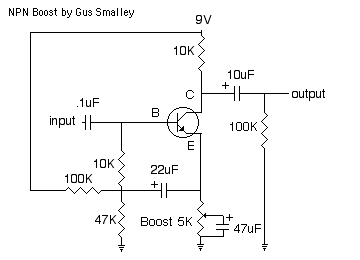
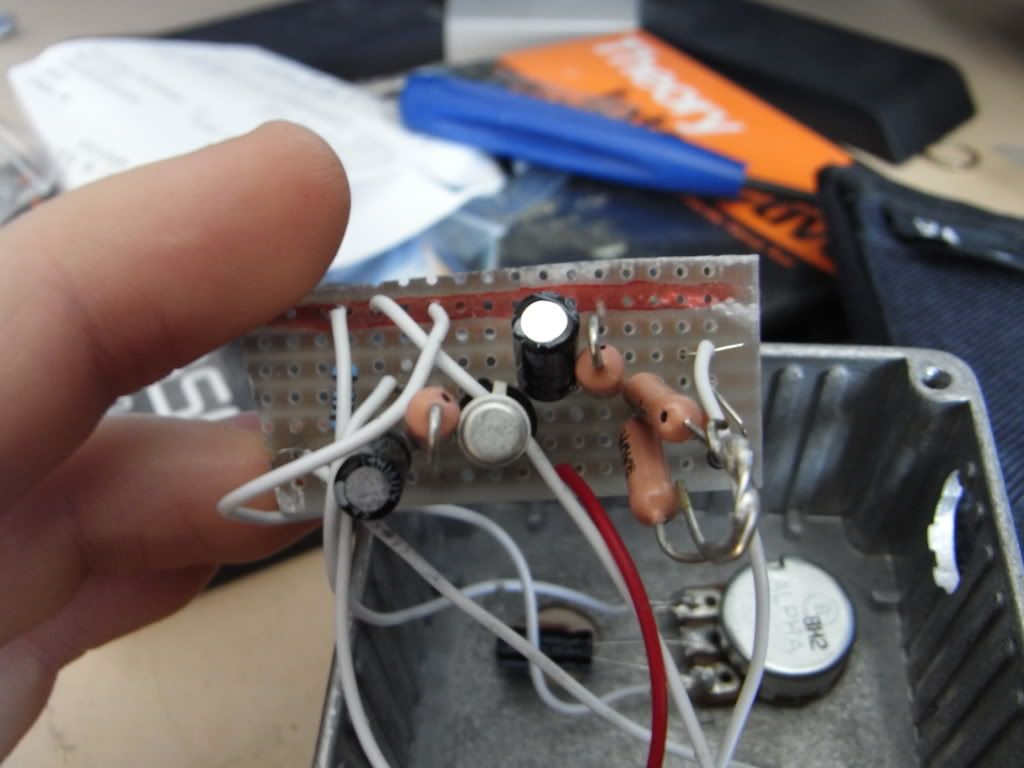
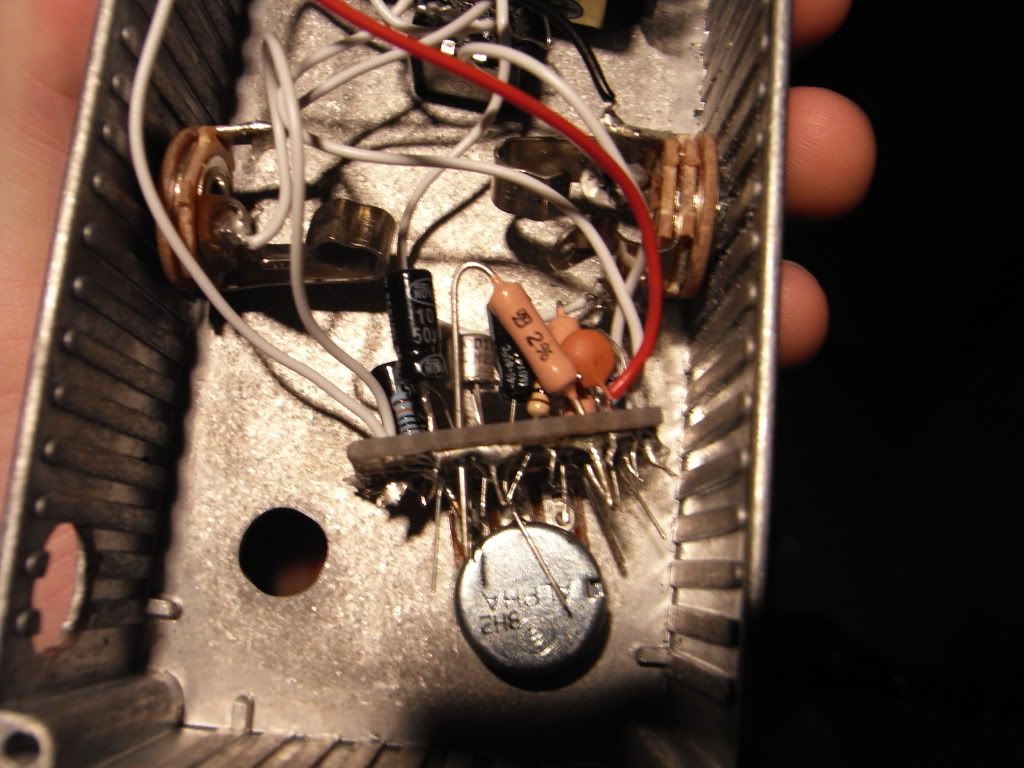
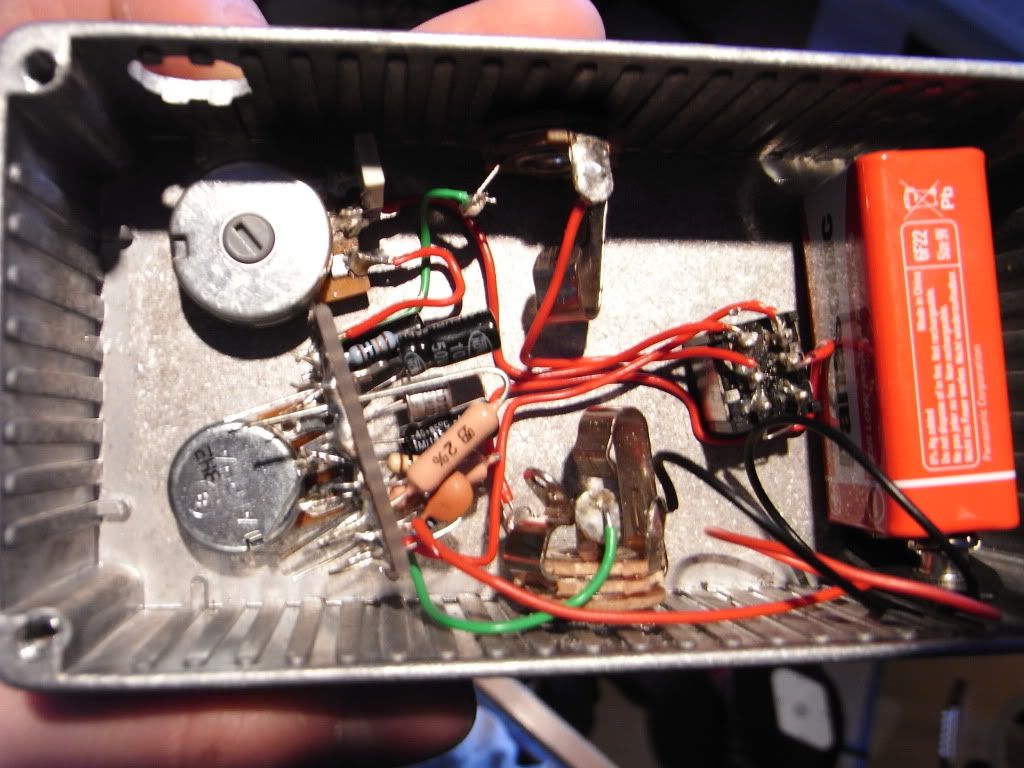
I've been quiet on the blogging front and that isn't a reflection on whether or not I've seen any good films, read any good books, listened to any good albums, played any good guitars (quite the contrary) but rather a reflection on my level of enthusiasm towards blogging. Anyway, a new post is overdue and I've recently built the diystompboxes.com NPN Boost pedal in an effort to show how easy it is to get started with pedal building to the pedal-obsessed folks at afterthepostrock.com. Here are a few photos I have taken along the way along with my parts lists, the diystompboxes.com schematic and the layout I used.

The original schematic from diystompboxes.com


My, ever so slightly edited schematic with the 10k resistor from the 9v to the collector changed to a 5k resistor to better accommodate a change in the transistor from a 2n3904 to a 2n2222a.

Caps:
.1uF
10uF electrolytic
22uF electrolytic
47uF electrolytic

Resistors
2x100K
5K
10K
47K
5K Linear Potentiometer

Transistor:
2n2222a

and the obvious...

DPDT switch
Battery snap
Mono Jack
Stereo Jack

Parts list, add a 100k lin pot and a 10nF cap for the tone control.


My first rough and scruffy build straight from the edited schematic.

I then made a layout for a more compact, neater layout with the potentiometer mounted onto the board and decided to add a simple les paul style tone control to allow a bit of attenuation of the highs.


The layout I made up using a great, free tool from Storm Software. There are some breaks in the board that aren't visible on the layout these beneath C1, C3 and R3.


The version with the panel mounted potentiometer.


The finished pedal with neater wiring and tone knob. For the tone knob I used a 10nF cap but it's worth playing around with different values to see what you like. It doesn't make a huge difference to the sound but it's noticeable, easy and useful.

This was a fun build and the end result sounds GREAT. I'm using it to drive my little Vox combo into overdrive at home and it's been worth the effort. You can find everything you need to build the original here

Thursday, 24 September 2009

Yamaha RGX A2

I've started doing some guitar repair work so I'm going to be doing some non-Harmony Central format reviews of the guitars that work on. I have just finished replacing the cylindrical style jack and sorting out one of the recessed knobs on a Yamaha RGX A2 and I'll talk about that guitar for a while.

Launched in 2006 the RGX A2 is Yamaha's attempt to create an innovative and futuristic guitar that "shatters the concept" of conventional guitar building listing their Alternative Internal Resonance system (A.I.R. for short), an LED pickup selection indicator and the bizarre choice of a cylindrical output jack that only Yamaha and Ibanez appear to employ in their guitars.


A.I.R. is a system used only in the RGX A2 and it's bass counterpart, the RBX4 A2, that claims to increase the resonance of lightweight guitars by spreading vibrations throughout the whole body of the guitar using "sound tubes". The absence of the system in any Yamaha guitars since the RGX and RBX suggests that the so-called "tonal revolution" of A.I.R. failed to spread to the consumer. After a while of playing the guitar it's easy to see why; you don't notice it. The RGX makes the same tonal sacrifice of other very lightweight guitars and A.I.R. makes little difference to that. I was not aware that the guitar used a design different to conventional guitar designs until I looked up the specifications on the internet so it appears to be no more than a marketing gimmick.

The other supposedly innovative feature of the RGX A2, the LED pickup selection indicator, is made essential by the inclusion of a 3-way rotary switch as the method of pickup selection. Although the LEDs are an attractive feature (see picture) their purpose ends there. The rotary switch is made fiddly by the stylishly recessed knobs and the guitar would be served better by a simple Les Paul style toggle switch.

Despite the gimmicks this guitar plays reasonably well and compares favourably to other Yamaha guitars in the price range (about £300 new), although it's nothing to rave about, it's a decent guitar. The £300 RRP puts it perilously close to the cheaper MIM Fender Strats and some of the better Epiphone Les Pauls, one a lighter weight and brighter guitar, the other a heavier and more tonally sound guitar than the Yamaha RGX A2. The RGX A2 is a compromise that is not strictly necessary and it's pseudo-futuristic gimmicks don't save it from being a less than sensational piece of kit.